Home automation and domotics in prestigious residences: the value you cannot see but can feel
The most sophisticated technology is the one you do not notice. It is felt in comfort, in security, in the quiet quality of every moment of the day.
Walking into your home and finding the temperature already perfect. Seeing the lights adapt to the time of day without anyone touching a switch. Knowing that the property is monitored while you are out at dinner, and receiving a notification on your phone if something is wrong. Leaving on a business trip and managing every aspect of your residence from another city, or another country.
This is not science fiction. It is the everyday reality of those who live in a prestigious residence equipped with a carefully designed home automation system. And more and more often, it is one of the criteria by which our clients assess and choose a property.
What home automation really is, and why it is different in prestigious residences
The word domotics comes from the Latin domus, home, and sums up the integration of all the home’s systems (lighting, climate control, security, audiovisual, energy management) into a single intelligent, centralised architecture. It is not about individual smart devices scattered around the house, but a system that makes them communicate in a coordinated way, responding to the habits and preferences of those who live in those spaces.
In high-end residences, the reference standard is the KNX protocol: an open, internationally recognised standard that allows devices from different manufacturers to communicate and integrate seamlessly. It is the common language that allows the home to function as a single organism rather than a sum of disconnected appliances. According to the KNX association, extending KNX to more functions and applications can deliver energy savings of up to 60%.
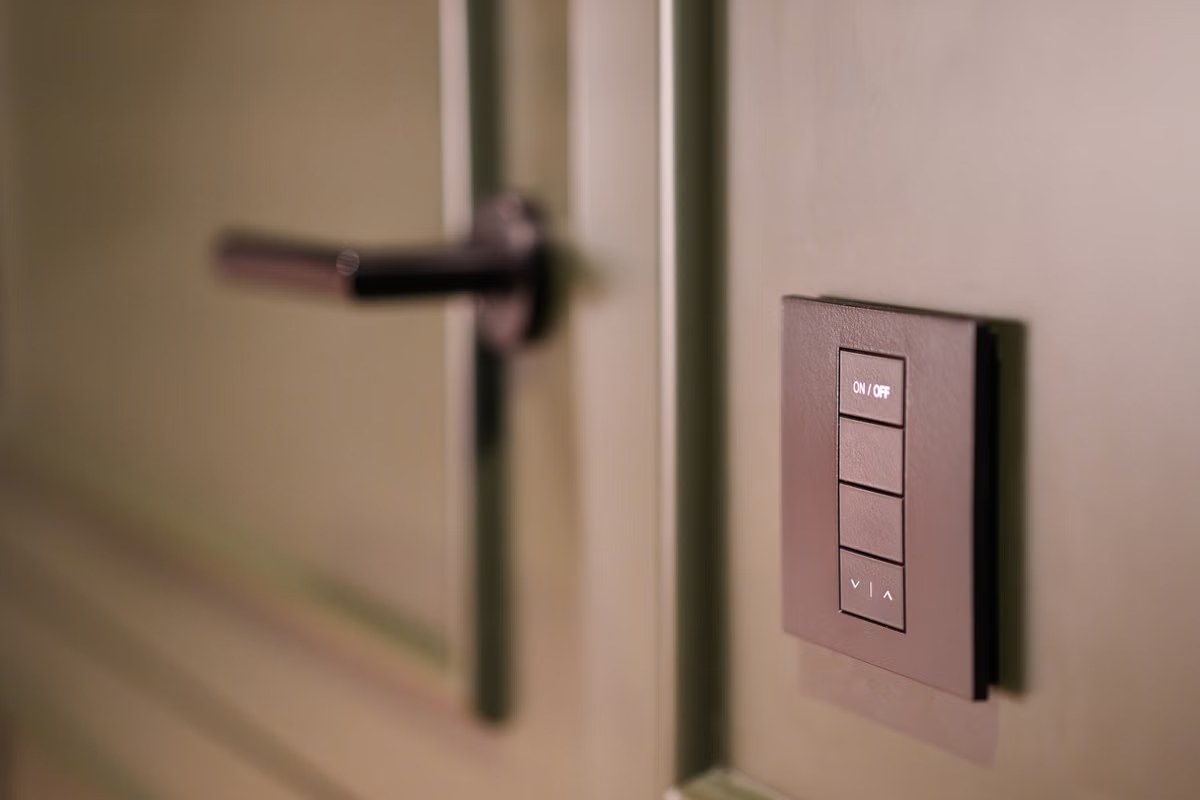
The difference between a basic system and a high-end one is not only technical: it is a matter of design philosophy. In prestigious residences, home automation is conceived together with the architecture, not added at a later stage. It is invisible by design and is perceived only through the experience of living in a space that always seems to know what you want.
Light: the detail that transforms every room
Lighting is the first area in which home automation expresses its full potential in prestigious residences. It is not simply a matter of switching lights on and off remotely, but of creating lighting scenes that change according to the time, the activity and the mood, transforming the same space into something radically different over the course of the day.
The entrance light that comes on softly when you return home. The living room that prepares for a dinner with a carefully studied dimming sequence. The bedroom that wakes up with a gradual light simulating dawn, without a sudden awakening. The colour temperature of the light adapts to the natural light outside, always maintaining optimal visual quality.
DALI (Digital Addressable Lighting Interface) systems allow every single light source to be controlled independently, with a precision and flexibility that traditional systems cannot approach. The result is a living experience that can rarely be described in full. It is felt, it is lived, but it is hard to put into words until you have experienced it in person.
Climate: tailored comfort, optimised consumption
Climate control is the second system that home automation profoundly transforms. In prestigious residences, climate management is not uniform throughout the apartment: it is multi-zone, calibrated for each room according to its use, its exposure and the actual presence of people.
Smart thermostats learn the occupants’ habits and adjust the temperature in advance, not in reaction. They know that on Wednesdays dinner is late and that on Fridays the owner comes home from work earlier. They know that the guest room needs two hours’ notice to reach the ideal temperature. And they coordinate everything with the solar shading panels, optimising both thermal comfort and energy consumption.
The savings are not marginal: a well-managed smart home can significantly reduce annual consumption. According to the Osservatori of the Politecnico di Milano, in 2025 the smart home market in Italy reached the one billion euro mark, growing by 11% on the previous year: a figure confirming that this is no longer a niche, but a structural component of the quality property market. In large residences, the savings translate into significant amounts and have a direct impact on the property’s energy class.
Security: from reactive to predictive
Security is perhaps the area in which home automation has made the most significant leap in quality in recent years. The integrated systems in prestigious residences do not merely detect intrusions that have already happened: they anticipate them, deter them, and manage every scenario with a sophistication that traditional systems cannot replicate.
High-resolution IP cameras integrated into the building’s architecture, perimeter motion detectors, opening sensors on windows and doors, access control systems with biometric recognition or a personal code for each user: everything converges in a single monitoring platform, accessible in real time from any device.
KNX Secure, the version of the KNX standard with advanced encryption, ensures that the system itself is protected from digital intrusions: an increasingly important aspect at a time when the connectivity of homes opens up new vulnerabilities, to be guarded with the same care as physical security.
But the real innovation lies in integration: security is not a separate system, but part of the home’s overall intelligence. When away mode is activated, the lights simulate presence with programmed sequences, the shutters move naturally, the system monitors every anomaly and sends instant notifications. The home protects itself, silently and invisibly.
Property value: home automation as an investment
Home automation is not just a matter of comfort: it is an investment that is reflected in the value of the property in a measurable way.
In the large cities of northern Italy, advanced home automation is increasingly present in new-build properties, and demand from buyers of prestigious residences is growing steadily. A well-designed home automation system increases the perceived and real value of a property, shortens sale or rental times, and positions the residence in a higher market bracket.
There is also a tax aspect to consider: in Italy, the 2026 home automation bonus allows a deduction of 50% (main residence) or 36% (other homes) of the cost of building automation works aimed at the energy upgrading of the property. An incentive that makes investing in high-quality integrated systems even more worthwhile, alongside the long-term benefits of an improved energy class.
It is one of the elements that increasingly enters the assessment of those looking for a prestigious residence and, where it is absent, becomes a point of negotiation on price.
Invisibility as a value
There is a fascinating paradox at the heart of high-end home automation. The more sophisticated a system is, the less you see it. The ultimate technology is the one that disappears into everyday experience and requires no effort. A well-automated prestigious residence does not present itself as a spaceship full of screens and buttons. It presents itself as a home that works perfectly, that responds before a request is even made, that protects without making you feel watched, that saves energy without anyone thinking about it. It is technology that serves life, not technology that complicates it.
At Via della Spiga Wonderful Houses, the presence and quality of a home automation system are among the elements we assess carefully, because we know that our clients are not only looking for a beautiful home, but for a home that can live up to the way they want to live.
Discover our properties: www.viadellaspiga.info
Via della Spiga Wonderful Houses · via T. Salvini 10, Milan · info@viadellaspiga.info · +39 02 66661260